


The concept of a self-cleaning home was once relegated to the realm of science fiction, depicted in futuristic cartoons and speculative literature. Today, that vision is a tangible reality, largely driven by rapid advancements in automated floor cleaning technology. The modern household is busier than ever, and finding time to maintain pristine floors is a constant challenge. Enter modern Robot Vacuums: intelligent, autonomous, and highly efficient machines that have fundamentally transformed the way we approach household chores. Obtain the Best information about Robot Süpürge.
Over the past decade, these devices have evolved from chaotic, bumper-car-style gadgets that aimlessly bounced off walls into sophisticated, laser-guided cleaning companions. This transformation is not just about convenience; it is a vital component of the broader home automation movement. By integrating seamlessly into our daily routines and smart ecosystems, Robot Vacuums allow us to reclaim countless hours previously lost to sweeping, mopping, and vacuuming.
In this comprehensive guide, we will explore the cutting-edge features that define today’s top-tier cleaning robots. From advanced navigation systems and deep-cleaning mechanisms to the ultimate convenience of self-emptying docks, we will break down everything you need to know. Whether you are a tech enthusiast looking to upgrade your current setup or a first-time buyer wondering if these devices truly live up to the hype, this article will serve as your definitive resource.
The Evolution of Automated Floor Care
To appreciate the marvels of modern cleaning robots, it is helpful to look back at how far they have come. Early models relied entirely on contact sensors. They would drive in a straight line until they hit a piece of furniture, turn at a random angle, and continue. While novel, this approach often left entire sections of a room untouched and resulted in extended cleaning times.
Today’s machines are equipped with onboard computers, artificial intelligence, and arrays of environmental sensors that rival those found in autonomous vehicles. They map your home, recognize specific rooms, avoid temporary obstacles, and even empty their own dustbins.
Are Robotic Sweepers Worth the Investment?
A common question among consumers transitioning from traditional cleaning methods is: are robotic sweepers worth the investment? The short answer is a resounding yes, provided you choose a model that aligns with your household’s needs.
To break down the return on investment, consider the following factors:
- Time Savings: The average person spends over an hour a week vacuuming. A robot reclaims over 50 hours of your time annually.
- Consistent Cleanliness: Because they can be scheduled to run daily, robots maintain a baseline level of cleanliness that is difficult to achieve manually, drastically reducing the accumulation of dust, pet hair, and allergens.
- Prolonged Floor Life: Regular removal of abrasive dirt and sand prevents microscopic scratches on hardwood floors and keeps carpet fibers from matting down.
While the initial upfront cost of a premium model can be significant, the long-term benefits of a consistently clean home and the luxury of free time make it a highly justifiable purchase for most modern households.
Navigating the Domestic Landscape: How Robots “See”
The single most important feature of any automated cleaner is its ability to navigate your home efficiently and safely. A vacuum with incredible suction is useless if it constantly gets stuck under the sofa or falls down the stairs. Modern navigation relies on a combination of hardware sensors and sophisticated software algorithms.
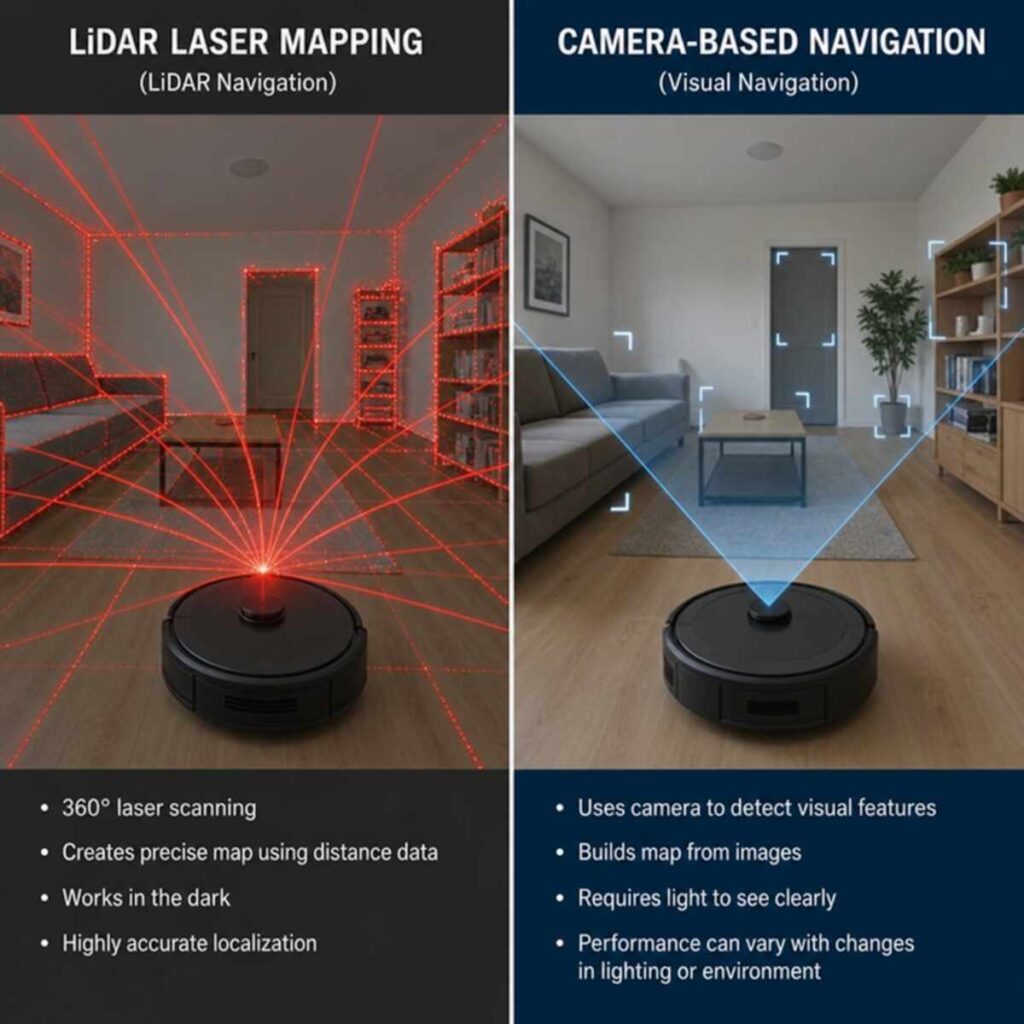
LiDAR Navigation vs Camera Mapping
When shopping for a premium robot, you will frequently encounter two dominant mapping technologies: LiDAR and vSLAM (Camera Mapping). Understanding the difference is crucial for selecting the right device for your home.
LiDAR (Light Detection and Ranging) LiDAR works by spinning an invisible laser on top of the vacuum, measuring the time it takes for the light to bounce back from walls and furniture.
- Pros: It is incredibly fast and highly accurate. A LiDAR robot can map an entire floorplan in minutes without needing to physically explore every inch. Furthermore, because it relies on lasers rather than ambient light, LiDAR navigation works perfectly in pitch-black rooms—ideal for nighttime cleaning.
- Cons: The spinning laser turret adds height to the vacuum, which might prevent it from fitting under very low-clearance furniture. Reflective surfaces, like floor-to-ceiling mirrors, can occasionally confuse the lasers.
Camera Mapping (vSLAM – Visual Simultaneous Localization and Mapping) Camera-based robots use optical lenses to capture thousands of data points in a room, identifying landmarks like ceiling corners, doorways, and furniture edges to determine their location.
- Pros: These robots can often have a lower profile since they don’t require a raised laser turret. Advanced camera systems are also increasingly being used in tandem with AI to recognize specific objects (like shoes or cables).
- Cons: Cameras require ambient light to “see.” If you schedule a camera-based robot to clean a dark basement at midnight, it may become disoriented or refuse to run. They also take slightly longer to generate an initial map compared to LiDAR.
The Verdict: While both technologies are massive upgrades over random-bounce navigation, LiDAR navigation generally offers a more reliable, precise, and faster mapping experience for the average user, especially those who prefer running their vacuums at night.
Obstacle Avoidance Sensors and Drop Detection
Even with a perfect map, a home is a dynamic environment. Chairs are moved, shoes are left in hallways, and charging cables are dropped on the floor.
Modern units utilize front-facing obstacle avoidance sensors—often employing 3D structured light or secondary AI cameras—to detect temporary hazards in real-time. Instead of plowing into a pet toy or tangling a phone charger in its brushes, the robot identifies the object, calculates its dimensions, and smoothly steers around it, noting the obstacle on your smartphone app.
Equally important is drop detection. Located underneath the front bumper, infrared “cliff sensors” constantly scan the floor directly ahead of the robot. If the infrared beam fails to bounce back immediately—indicating the edge of a staircase or a severe drop-off—the robot stops instantly and reverses course. This standard but vital technology ensures your investment doesn’t take a fatal tumble down the stairs.
Multi-Floor Mapping Capabilities
For homes with multiple stories, moving the robot between levels used to mean erasing the map and starting over. Today’s advanced software features multi-floor mapping capabilities. The robot’s onboard memory can store anywhere from three to ten distinct floor plans.
When you carry the robot upstairs and press “clean,” it takes a few seconds to scan its surroundings, recognizes the new floor plan, and begins a systematic cleaning route. It will even remember specific no-go zones and room customizations applied to that specific floor.
Redefining Cleaning Power
Navigation gets the robot where it needs to go, but the actual cleaning mechanisms are what leave your floors pristine. The anatomy of a robot vacuum’s cleaning system involves side brushes to sweep edges, a main rolling brush to agitate dirt, and a vacuum motor to pull the debris into the dustbin.
Demystifying Suction: Suction Power Measurement in Pascals
When comparing models, you will inevitably see the term “Pa,” which stands for Pascals. Suction power measurement in pascals indicates the static pressure the vacuum motor can generate to lift dirt.
- 1000 – 2000 Pa: Suitable for hard floors (wood, tile, laminate) and picking up light dust and pet hair.
- 2000 – 4000 Pa: Excellent for medium-pile carpets and pulling heavier debris like cereal or cat litter from crevices.
- 5000 – 8000+ Pa: The current high-end standard. This level of power excels at deep-cleaning high-pile carpets and extracting embedded dirt that has been ground into fibers over time.
Actionable Tip: Don’t rely solely on the Pa number. High suction is easily wasted if the robot doesn’t have an effective brush roll to agitate the carpet fibers and create a seal against the floor.
The Best Smart Cleaners for Pet Hair and Dander
Pet owners face a unique set of challenges: endless shedding, scattered kibble, tracked-in mud, and invisible dander. The best smart cleaners for pet hair and dander are equipped with specific features designed to tackle these issues head-on.
Firstly, look for models utilizing dual rubber brush rolls instead of traditional bristled brushes. Bristles act like a magnet for long pet hair, wrapping it tightly around the roller until the machine jams. Solid rubber rollers with tread patterns effectively pull hair into the suction path while resisting tangles. Most hair that does wrap around a rubber roller is easily pushed to the removable ends, making maintenance a breeze.
Secondly, high-efficiency filtration is non-negotiable for pet owners. Vacuums equipped with true HEPA filters capture 99.97% of particles as small as 0.3 microns. This traps microscopic pet dander and allergens inside the dustbin instead of exhausting them back into the air you breathe.
Autonomous Mopping and Sweeping Hybrids
Perhaps the most significant leap in recent years is the transition from single-function vacuums to autonomous mopping and sweeping hybrids. Early 2-in-1 models simply dragged a damp microfiber cloth behind the vacuum—effective for light surface dust, but useless against dried spills.
Modern hybrids utilize active scrubbing technologies:
- Sonic Vibration: The mop plate vibrates thousands of times per minute (up to 3,000 scrubs/minute), mimicking the scrubbing motion of a human hand to break down sticky messes.
- Dual Spinning Pads: Two circular mop pads rotate rapidly under downward pressure, providing intense friction to clean heavily soiled hard floors.
The Carpet Dilemma Solved: A major issue with early hybrids was their inability to clean both carpets and hard floors in a single run without getting the carpet wet. Today, premium robots feature auto-lifting mop brackets. When the ultrasonic sensors detect carpet, the robot automatically halts water flow and retracts the mop pad upward by several millimeters, seamlessly transitioning to high-power vacuuming without dampening your rugs.
The Ultimate Convenience: Base Stations
If you ask any long-time robot vacuum owner about their biggest pain point, it is usually emptying the tiny onboard dustbin. Because robots are compact, their internal bins hold only about 300 to 500 milliliters of debris, requiring manual emptying after every single cleaning run.
This brings us to the revolution of the automated dock.
Self-Emptying Base Station Benefits
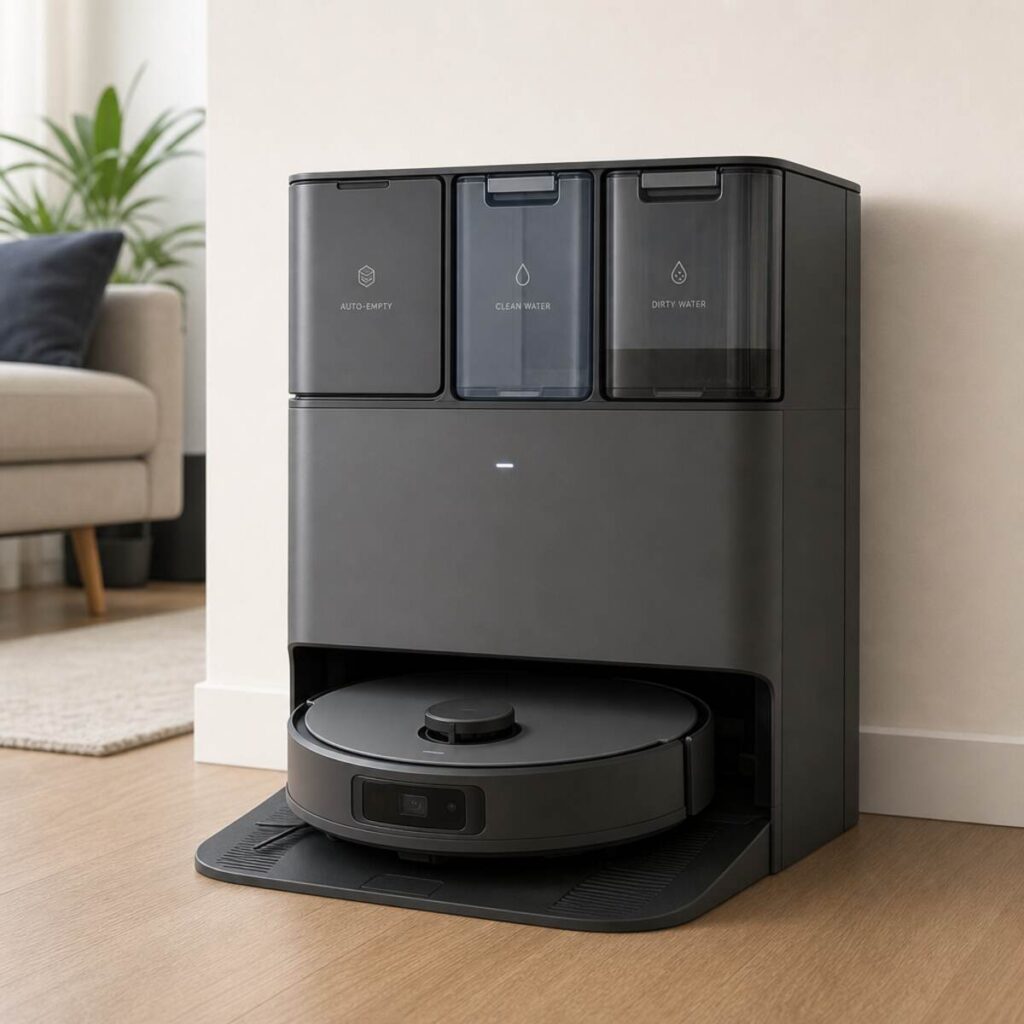
The introduction of the auto-empty dock changed the paradigm of robotic cleaning. When the robot finishes its route and returns to the base, a secondary, highly powerful vacuum motor inside the dock activates. It violently sucks the dirt, hair, and dust out of the robot’s small bin and pulls it into a large, sealed, disposable bag housed within the base station.
The self-emptying base station benefits are numerous:
- True Hands-Free Operation: A typical base station bag holds up to 60 days’ worth of dirt. You only need to think about vacuuming six times a year.
- Enhanced Hygiene: Emptying a standard robot bin over a trash can usually results in a plume of dust escaping back into the air. Auto-empty bags seal themselves upon removal, locking allergens away—a massive benefit for asthma and allergy sufferers.
- Uninterrupted Cleaning: If a robot’s bin fills up halfway through cleaning a large house, it will pause the job, return to base to empty itself, and then resume exactly where it left off.
All-in-One Wash Stations
For mopping hybrids, the base station evolution has gone even further. “All-in-One” or “Omni” stations now manage the entire mopping process automatically.
- Auto-Washing: Before, during, and after a cleaning run, the robot returns to the dock where the base station scrubs the mop pads with clean water to ensure it isn’t just dragging a dirty cloth across your floors.
- Auto-Refilling: The base tops up the robot’s internal water tank from a larger reservoir in the dock, ensuring consistent moisture levels.
- Auto-Drying: To prevent mold, mildew, and foul odors, high-end docks blow warm air across the mop pads after the job is done, drying them completely.
Software Customization: Taking Control with Apps
Hardware is only half the equation; the software dictates how intelligently the hardware is used. Modern companion apps turn your smartphone into a command center for your home automation setup.
Room Mapping and Scheduling
Once the robot has mapped your home, the app will automatically partition the map into distinct rooms (Kitchen, Living Room, Hallway). If it makes a mistake, you can manually merge or divide rooms.
This enables highly specific scheduling. Instead of cleaning the whole house, you can program the robot to clean the kitchen and dining room every night at 8:00 PM after dinner, and vacuum the bedrooms only on Tuesday and Thursday mornings.
How to Set Up Virtual No-Go Zones
There are always areas in a house where a robot shouldn’t venture—a chaotic children’s playroom littered with tiny Legos, a delicate antique rug, or the area around a maze of computer wires. In the past, manufacturers provided magnetic strips that you had to physically tape to the floor to block the robot.
Today, learning how to set up virtual no-go zones is entirely digital and incredibly simple:
- Open your robot vacuum’s companion app and navigate to the map view.
- Select the “Map Management” or “Zones” feature.
- Choose the “No-Go Zone” (usually represented as a red box) or “Invisible Wall” (a red line) option.
- Pinch and drag the box or line over the specific area on your digital floor plan where you want to restrict access.
- Save the map.
You can also set “No-Mop Zones.” This allows the robot to drive over an area to vacuum it, but tells it not to deploy its mop pads. This is perfect for area rugs if your robot does not feature an auto-lifting mop bracket.
Integrating with the Smart Home Ecosystem
A truly smart home is interconnected, where devices communicate with one another to create a seamless living experience. Robot Vacuums are at the forefront of this integration.
Smart Home Integration with Voice Assistants
Virtually all modern Wi-Fi-enabled vacuums offer smart home integration with voice assistants, including Amazon Alexa, Google Assistant, and Apple Siri.
Linking your vacuum to these ecosystems allows for incredible convenience. If you spill flour while baking, you don’t need to wash your hands, find your phone, open the app, and select the kitchen. You simply say, “Alexa, tell the vacuum to clean the kitchen,” and the robot deploys immediately.
Furthermore, you can integrate the vacuum into broader home automation routines. For example, you can create an “Away” routine. When you leave the house and lock your smart door, the system automatically turns off the lights, adjusts the thermostat, and signals the robot vacuum to begin its daily cleaning cycle while you are out, ensuring you always return to a clean home without ever hearing the vacuum run.
Troubleshooting Common Connectivity Issues
Despite the seamless ideal, wireless technology can occasionally be temperamental. If you are setting up your device, troubleshooting common connectivity issues usually comes down to a few standard fixes:
- The 2.4GHz Wi-Fi Requirement: This is the most common hurdle. Almost all robot vacuums require a 2.4GHz Wi-Fi network to connect. While 5GHz networks are faster, 2.4GHz waves travel further and penetrate walls better, making them ideal for a device driving through a multi-room home. If your router uses a single name (SSID) for both bands (band steering), you may need to temporarily disable the 5GHz band in your router settings just to complete the initial vacuum setup.
- Distance to Router: Base stations should be placed in areas with strong Wi-Fi signals. If the dock is hidden in a deep, concrete basement corner, the robot may fail to download firmware updates or receive cleaning schedules.
- App Permissions: Ensure the companion app has Bluetooth and Local Network permissions enabled on your smartphone during setup, as these are often used to pass the Wi-Fi credentials to the robot.
Power Management: Ensuring the Job Gets Done
Autonomous cleaning requires intelligent power management. Understanding how a robot handles its battery life is key to understanding its capabilities.
Battery Capacity and Area Coverage
Battery capacity in these devices is measured in milliampere-hours (mAh). Entry-level models might feature 2600mAh batteries, while premium models boast 5200mAh to 6400mAh batteries.
A larger battery allows the robot to run longer on a single charge—often up to 180-200 minutes on the lowest suction setting. This translates to covering well over 2,500 square feet of hard flooring before needing to recharge. However, be aware that max suction modes, active scrubbing mopping, and thick carpets will drain the battery significantly faster.
Battery Life and Auto-Recharge Functionality
You do not need to worry if you live in a massive home that a robot cannot clean on a single charge. Thanks to intelligent battery life and auto-recharge functionality, the robot manages itself.
When the battery dips to around 15% to 20%, the robot will pause its current cleaning task, turn off its suction motor to conserve power, and navigate back to its base station. Once it has recharged to an adequate level (usually around 80%), it utilizes its internal map to drive back to the exact square foot where it left off, resuming the cleaning cycle until the entire house is finished. This “Resume and Clean” feature ensures comprehensive coverage of any floor plan, regardless of size.
Maintenance: Protecting Your Investment
While modern robots automate the act of cleaning, they are still physical machines that require periodic maintenance to function at peak efficiency. Neglecting these tasks will lead to decreased suction, navigation errors, and a shorter lifespan for the device.
Routine Upkeep
Establishing a simple routine will keep your robot running smoothly for years.
Weekly Tasks:
- Wipe Down Sensors: Use a clean, dry microfiber cloth to gently wipe the cliff sensors underneath the robot, the wall sensors on the side, and the LiDAR dome or camera lens on top. Dust accumulation on these sensors is the leading cause of navigation errors and erratic driving behavior.
- Check the Main Brush: Even with anti-tangle rubber rollers, long hairs or strings can occasionally wrap around the axels. Pop out the main brush roll and clear any debris from the ends.
Maintaining HEPA Filters and Side Brushes
Two of the most critical components for cleaning performance are the filters and the edge-sweeping brushes.
- Filters: Maintaining HEPA filters and side brushes is paramount for suction and air quality. The HEPA filter catches microscopic dust, and over time, the pores become clogged, restricting airflow and reducing suction power measurement in pascals drastically. Every two weeks, remove the filter and tap it vigorously against the side of a trash can to dislodge fine dust. Some filters are washable; if so, rinse them with cold water (no soap) and let them air dry for a full 24 hours before reinstalling. Even with regular maintenance, HEPA filters should be completely replaced every 3 to 6 months.
- Side Brushes: The spinning side brushes take a lot of abuse, constantly rubbing against baseboards and chair legs. Over time, the arms can become bent, frayed, or tangled with hair. Check them weekly to pull off any trapped hair. If the bristles look permanently bent out of shape, they can often be revived by dipping them in hot water for a few seconds. Regardless, expect to replace the side brushes every 6 months to maintain edge-cleaning efficiency.
Building a Cleaning Arsenal: The Right Tool for the Job
As incredible as Robot Vacuums are, they are not magic. They are part of a broader ecosystem of household cleaning tools. A common dilemma for consumers is deciding between automated systems and manual stick vacuums.
Comparing Cordless Sticks to Hands-Free Units
When comparing cordless sticks to hands-free units, it is not a matter of which one is objectively better, but rather how they complement each other.
The Case for Robot Vacuums: Robots excel at maintenance cleaning. Their primary value is doing the boring, repetitive work of keeping the floors free of daily dust, crumbs, and pet hair. They clean the entire floor plan autonomously, ensuring a high baseline of cleanliness. They easily slide under beds, sofas, and heavy furniture that are notoriously difficult to reach manually.
The Case for Cordless Vacuums: Cordless vacuums are champions of targeted cleaning and verticality.
- Spill Response: If you drop a bowl of dry cereal in the kitchen, grabbing a stick vacuum to clean that specific spot takes 10 seconds. Deploying a robot takes longer.
- Stairs and Upholstery: Robots cannot clean stairs, nor can they clean the cushions of your couch, the interior of your car, or the cobwebs in the corner of the ceiling.
- Deep Carpet Cleaning: While robot suction is impressive, the raw physical power and heavy agitation of a high-end stick vacuum are still superior for a seasonal deep-clean of thick carpeting.
The Ideal Setup: The most efficient modern households employ a hybrid approach. They use a robot vacuum to handle the daily floor sweeping and mopping automatically, significantly reducing the overall cleaning workload. Then, they keep a lightweight cordless vacuum mounted on the wall for quick spot-cleaning, stairways, and above-floor dusting. Together, they create a comprehensive, low-effort home cleaning strategy.
The Future of Automated Floor Care
The trajectory of automated floor cleaning technology points toward even greater autonomy and intelligence. We are already seeing the integration of advanced Artificial Intelligence that doesn’t just avoid obstacles, but categorizes them—distinguishing between a dropped sock and a pet accident, adjusting its behavior accordingly.
Future iterations are heavily focused on overcoming the final physical barriers in the home. Engineers are actively developing prototypes capable of climbing stairs, utilizing articulated wheel bases or tank-tread designs. Furthermore, we are beginning to see edge-cleaning arms—mechanisms that extend the side brush or mop pad outward from the robot’s circular body to reach deeply into 90-degree corners, completely eliminating the tiny blind spots left by current circular models.
As smart homes become more cohesive, we can expect robots to communicate with other appliances. Imagine a scenario where your smart air purifier detects high particulate matter in the living room and automatically dispatches the robot vacuum to address the source of the dust. The line between domestic appliances and active home-management robots is blurring rapidly.
Conclusion
The era of spending weekends pushing a heavy vacuum around the house is fading, replaced by the quiet efficiency of home automation. From navigating complex floor plans with military-grade lasers to scrubbing dried spills and emptying their own dustbins, modern Robot Vacuums are true marvels of consumer engineering.
By understanding the intricacies of LiDAR vs camera mapping, evaluating your needs regarding pet hair and mopping, and properly utilizing base stations and smart app integrations, you can select a device that perfectly complements your lifestyle. While they do require a minor investment of time for setup and routine maintenance, the return on that investment is immeasurable. They offer not just cleaner floors, but the gift of time—allowing you to focus on what truly matters while your intelligent companion handles the dirty work in the background.